Walk into a new restaurant, salon, gym, or coffee shop around Metro Atlanta and there is a good chance you will see it: a glowing script logo on the wall, a line of copy above the counter, or a bright piece of art that just about everyone stops to take a picture of. A lot of the time that glow is not old-school glass neon. It is LED neon, also called LED flex neon, and it has become a go-to choice for interior signs. Here is a plain-spoken look at what LED neon is, how it compares to traditional glass neon, where it works best, and what to have ready when you ask for a quote.
What LED Neon Actually Is
LED neon uses strips of LEDs set inside a flexible, diffused tube, usually silicone or a similar material. The tube spreads the light out so you see a smooth, continuous line instead of a row of little dots. That line is bent to follow your lettering or artwork and then mounted to a backer, most often clear or colored acrylic, which is cut to shape or left as a clean rectangle.
From across the room, a well-made LED neon sign reads a lot like classic neon: a bright, glowing line with that retro feel. Up close, and over the life of the sign, it behaves very differently, which is why so many businesses choose it today.
LED Neon vs. Traditional Glass Neon
Traditional neon is glass tubing bent by hand over a flame, filled with gas, and powered by a high-voltage transformer. It is a real craft, and for some historic or vintage-style projects nothing else will do. But for most businesses, LED neon is the more practical choice, and here is why.
It is far less fragile. Glass neon can crack if it is bumped, dropped during install, or knocked by a ladder or a careless elbow. LED neon is flexible and much more forgiving, which matters in busy restaurants, retail floors, gyms, and anywhere with kids around.
It runs at low voltage. Glass neon needs high voltage to light up. LED neon runs on a low-voltage power supply, which makes it a better fit for interiors where people are close to the sign.
It stays cooler. LED neon does not get as hot as glass tubes, so it can sit closer to walls, shelves, and decor.
It is easier to customize and repeat. Because the line is bent and mounted on a cut backer, it is straightforward to make a matching second sign for another location, or to build a design that would be hard to bend in glass.
It generally uses less energy. LEDs are efficient, so an LED neon sign is usually cheaper to run day to day than a glass neon sign of a similar size. If you leave your sign on through long business hours, that adds up.
The trade-off is that LED neon and glass neon do not look exactly the same. Glass neon has a particular depth and a look some people love. If you are restoring a vintage sign or want the real thing for a specific design reason, tell us and we will talk through it honestly. For most new interior signs, LED neon gives you the look without the headaches.
Where LED Neon Works Best
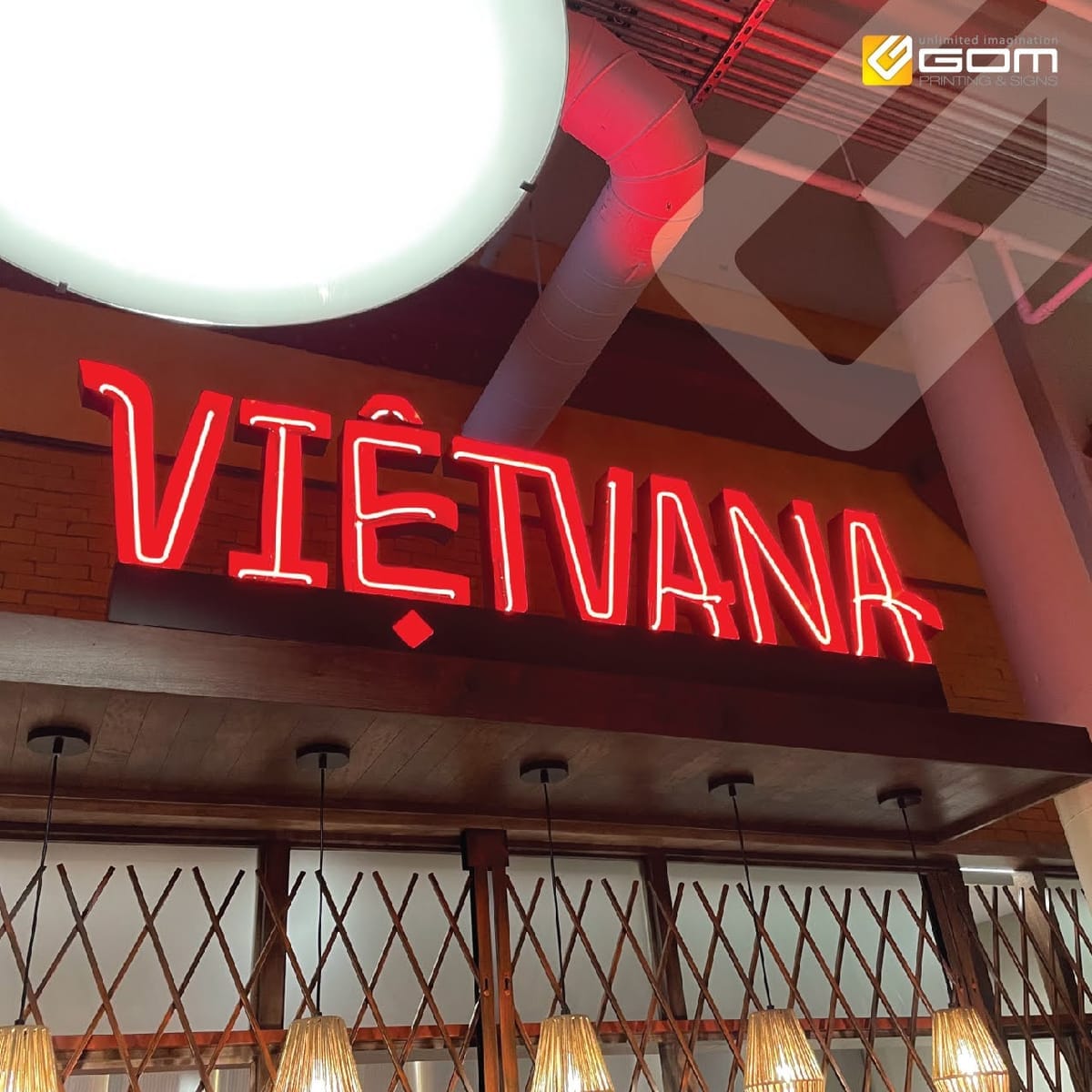
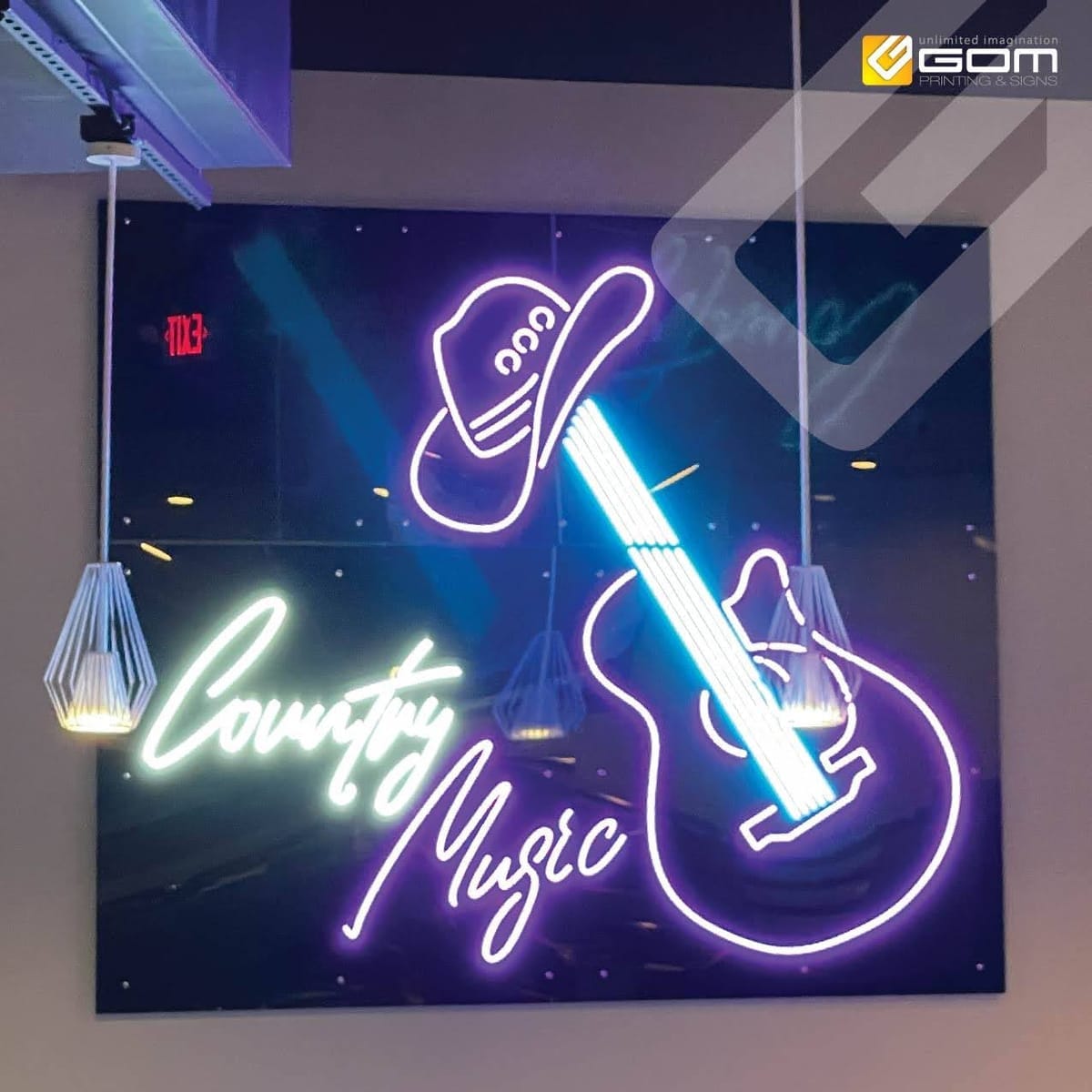
The photo at the top of this post is a good example of where LED neon shines: a feature wall in a dining room, mounted on a dark acrylic backer, with a script line, an illustration, and a few colors working together. Here are the places we see it used most:
Restaurants and bars. A glowing line of copy or a logo on the feature wall gives the room personality and gives guests a natural photo spot. It pairs well with printed wall graphics, which we covered in Restaurant Wall Graphics and Murals.
Salons, barbershops, and spas. A script logo behind the front desk or a short phrase over the mirror stations is one of the easiest ways to make a space feel finished and on-brand.
Coffee shops and dessert spots. Menu callouts, a signature phrase, or a small logo over the pickup counter all work well.
Gyms and studios. Motivational lines and logos on the main wall, where members see them every visit and post them online.
Offices and lobbies. A company logo in LED neon behind reception adds some energy to a lobby without the formality of a metal dimensional sign. If you want a more corporate look, a halo-lit logo may fit better, and our post Front-Lit vs. Halo-Lit vs. Back-Lit Channel Letters explains the difference.
Events and pop-ups. Because LED neon is lighter and tougher than glass, it travels better for trade show booths, pop-up shops, and events.
Indoor vs. Outdoor
Most LED neon signs we build are for interiors, including signs hung inside a storefront window facing the street. A sign in the window gives you an after-dark glow that people driving down Buford Highway or Peachtree Industrial can see, while the sign itself stays protected indoors.
Outdoor LED neon is possible, but it needs products and power supplies rated for outdoor use, the right mounting, and sealed connections. It may also need a permit, just like any other exterior lighted sign, and some cities and shopping centers have rules about exposed lighting or neon-style signs. If you want something on the outside of the building, channel letters are often the better long-term answer. Our guide The Sign Permit Process in Metro Atlanta covers the permit side, and if you lease, check your tenant sign criteria too.
Design Tips That Make a Big Difference
Keep the lettering simple enough to bend. LED neon is a single continuous line, so very thin serif fonts, tiny details, and small lettering can get lost. Script fonts and clean, bold shapes usually look best. We will adjust the artwork so it reads clearly once it is lit.
Think about size and viewing distance. A sign that looks right on your phone screen can feel small on a big wall. Measure the wall, think about where people will be standing when they see it, and size the sign for the room.
Pick colors on purpose. Warm white, cool white, and bright colors each set a very different mood. Many of our favorite pieces mix two or three colors, like a white script with a colored accent, instead of using every color available.
Choose the right backer. Clear acrylic lets the wall show through and makes the neon look like it is floating. A black or colored backer, like the one in our photo, gives more contrast and makes the colors pop. Cut-to-shape backers follow the outline of the design for a cleaner look.
Plan the power. LED neon needs a power supply and an outlet nearby, or an electrician to add one. Tell us where the closest outlet is, and we will plan the wiring so cords are hidden as well as possible. A dimmer or timer is worth asking about if you want to control the brightness or have it turn on and off with your hours.
Caring for an LED Neon Sign
LED neon needs very little maintenance. Dust the tube and backer with a soft, dry cloth now and then, and avoid harsh cleaners that can cloud acrylic. Keep the power supply somewhere it can breathe instead of buried behind cushions or stuffed into a tight cabinet. If a section ever stops lighting, call us; it is usually a connection or power supply issue that can be repaired rather than a reason to replace the whole sign. Our post Sign Maintenance Tips to Extend the Life of Your Investment has more general care advice.
Why Work With GOM Signs on LED Neon
GOM Signs designs, fabricates, and installs in-house out of Norcross, so your LED neon, your channel letters, your window graphics, and your interior signs can all come from one team with one consistent look. We can take a rough sketch or an existing logo and turn it into a design that actually works in neon, show you a proof before anything is built, and mount it for you so it is level, secure, and wired cleanly.
We work with restaurants, salons, churches, offices, and retailers across Metro Atlanta, including Norcross, Duluth, Suwanee, Lawrenceville, Doraville, Johns Creek, Alpharetta, and the City of Atlanta, and we serve clients throughout Georgia, Alabama, Tennessee, South Carolina, North Carolina, and Florida.
Get a Quote on Your LED Neon Sign
Have a logo, a phrase, or a sketch you want glowing on your wall? Send us the artwork, a photo of the wall, rough measurements, and the colors you have in mind. We will turn around a quote in about 48 hours. Call us at 678.205.0408 or request a quote through our website, and let us help you build the sign everyone wants to take a picture of.